How to be sure you’re training hard enough

Are you training hard enough?

We all exercise or train to become better versions of ourselves but we don’t always know how to get better. Years of experience in the gym and other training environments have shown that many people exercise, but most don’t do enough to get real results.  Exercise and training are there to push your body past limits so that it can adapt to the load, making you physically and psychologically stronger and fitter. However, there is also a chance of doing too much.

There are three main variables you can change to dial in your training to get fitter, stronger, or bigger.

Training volume

Volume is often inaccurately described as the duration of the training, however, it’s the quantity of activity performed during training. “It is the primary component of training because it’s a prerequisite for high technical, tactical, and physical achievement.” (Periodization, T.O. Bompa & G.G. Haff). The specifics of the volume will always depend on the sport or activity. For endurance athletes, the main component measured is the distance covered. Resistance training and weightlifting will measure the accumulative weight lifted during a workout (Volume Load = sets x reps x load in kg).
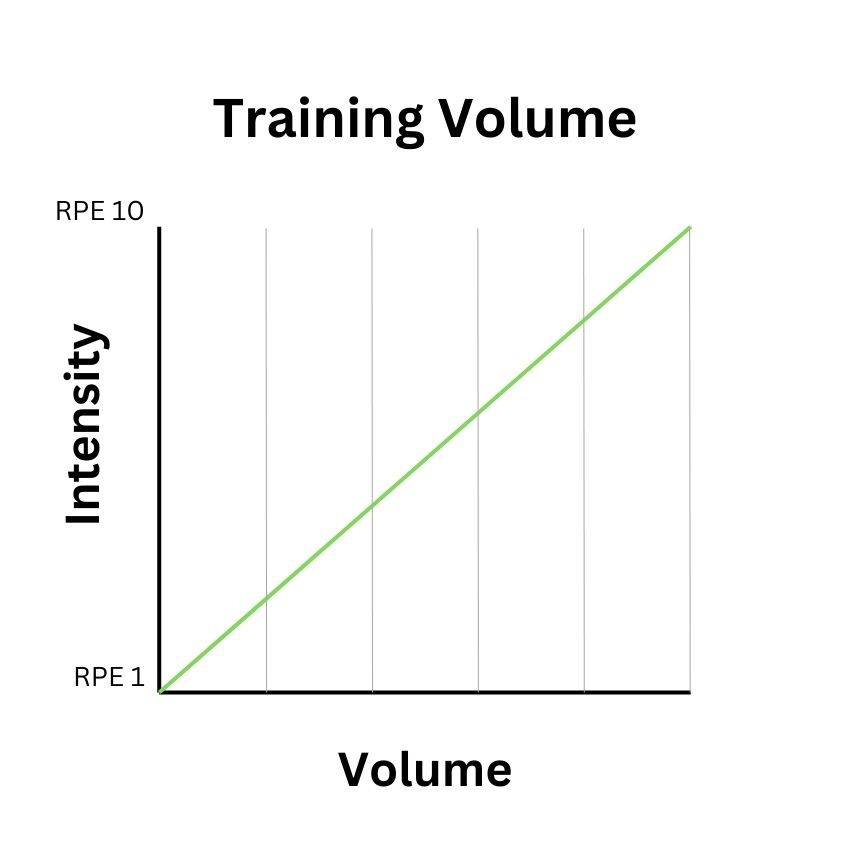
Training Volume graph
Training Volume

How can you increase training volume?

  • If you’re an endurance athlete work on increasing the distance covered per run or week.
  • Each week, try to add an extra rep or two to each set.
  • If you are building more capacity, add another full working set to the exercise.

To add volume, you’ll be adding distance, sets, and reps to the workout. Doing a higher volume workout will impact your recovery time between workouts.

Training Intensity

Where volume is the quantity of work during training, intensity can be seen as the quality of work being done. With relation to resistance training, intensity can be seen as the energy expenditure or work per unit of time. i.e. workout). The more work you do during a workout, the higher the intensity and fatigue accumulated. However, intensity also has a psychological component whereby your ability to handle and overcome mental challenges during a tough workout or training segment.

intensity is measured differently between sports and activities. Endurance athletes will look at average heart rate as they run, cycle, or row. Maximum heart rate will also be used during resistance training but power output will become increasingly important.
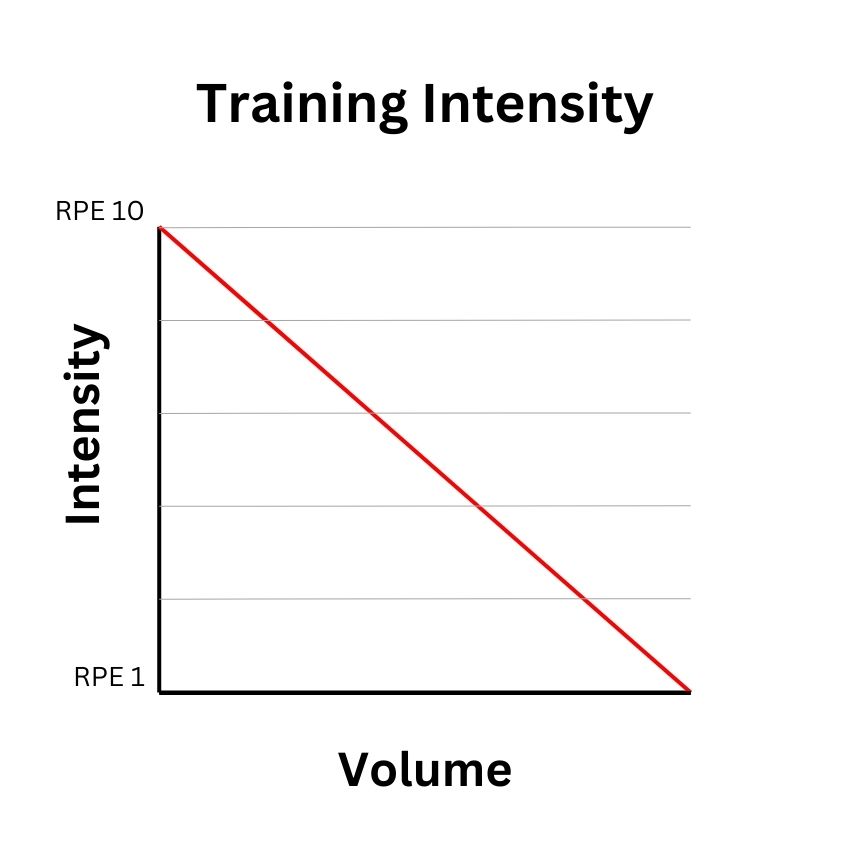
Training Intensity graph
Training Intensity

There are two easy-to-follow methods of assessing intensity when training.

REP (Rate of perceived exertion)

Training hard is very relative and you need to find your “sweet spot” for training. Each level of RPE is a guide for progression. Each intensity zone has its uses whether you’re training for endurance or weight training.

RPE Scale:

  • 1-4: This is where you’ll be warming up. You’ll either be jogging very slowly or doing mobility exercises, getting a light sweat.
  • 5-6: The warm-up and speed set intensity. Low intensity and moderate weights that slightly work the muscles to prepare for main activities or work on explosiveness. Endurance athletes will be able to chat but with laboured breathing.
  • 7-8: This is your working capacity. You’ll be doing your working strength sets or running but with shortness of breath and talking in short sentences.
  • 9: Pushing hard and barely able to maintain the intensity of the exercise. Reps are slowing down and form is becoming worse—barely anything left in the tank.
  • 10: You’ve pushed so hard that there is no way you can do another rep. Systemic and muscular failure happens here. Not recommended too often.

While RPE is great for endurance athletes, it can split those doing resistance training. RPE is perfect for powerlifters who work according to their maximal efforts. They tend to work with lower weights at higher intensity.

RIR: Reps in Reserve

If you want to build muscle, you could use the RIR method for your workouts. These are the reps in reserve for each set. It can be tricky to figure out, but so does the RPE scale. The more you use it, the better you’ll get.

You don’t want to start a new training block too heavy, so training each set to about 3 RIR is a good start (this could change in the final set). By adding weight each week, your reps in reserve will decrease and you’ll progressively get stronger.

Ways of altering intensity:

  • Increasing the speed over time or quickness of a specific exercise. E.g. running faster
  • Increase the weight lifted for an exercise.
  • Decreasing rest times between sets and exercises.
  • Performing endurance, interval, and tactical exercises at a higher % of maximal heart rate.
  • Have more intense training weeks before adding a deload week as part of a training block. E.g. 3;1 block to 4:1 training block.

Training Density

Training density is going to involve how often you’re training. The frequency of your workouts will depend on your training intensity and your recovery. If you’re recovering long before the next workout, you might consider adding another workout to your week. However, depending on your goals and program, increasing training frequency will look different to somebody else.

How to adjust training density:

  • If your muscles recover a few days before the next workout, adding another workout for that muscle group could improve adaptation. E.g. Training legs 2-3 times a week instead of once.
  • Have more speed sessions or longer runs during the week if you’re an endurance or track athlete.

Relationship between Volume and Intensity

There is a trade-off between volume and intensity. You can add all of the reps and sets you want, but it will impact how heavy you can load the bar. You can also run far but you won’t be running as fast as possible.

Optimal Volume and Intensity

If you’re building muscle, you will be adding loads of sets and reps to your workout to stimulate muscle growth, but you won’t be training very heavily. If you’re training for strength, your reps will be lower, rest times longer but the weight will be much heavier. You want to find the perfect zone for your specific goals.
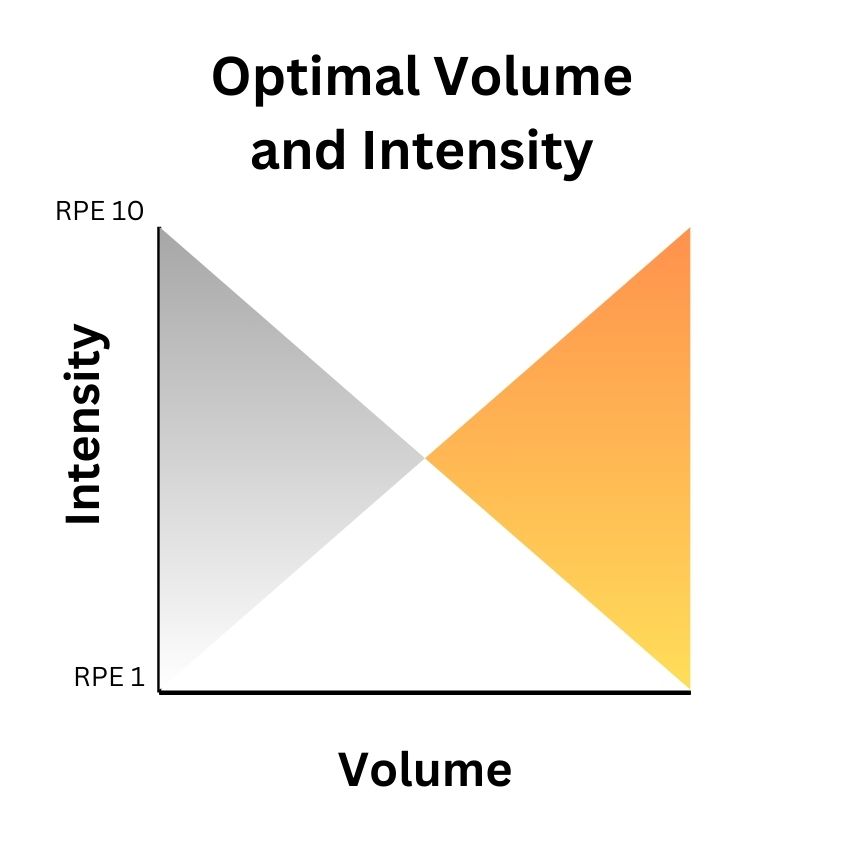
There is no special variation that suits everybody, which is why well-planned programs make such a big difference.

Avoidable Volume and Intensity

There are two more scenarios that you don’t want to find yourself in. These are often determined by no training plan, trying to follow elite athlete intensity, or being unable to train very hard.

You’ve got the group who often starts too heavy, always trains to failure and ego lifts with way too much weight on the bar. They load the intensity and increase the volume so much that they’re sore for a week, train with a sub-optimal range of motion, and increase the risk of injury.  This approach can also lead to overtraining.

The second group is often the beginners. They are unsure how to train effectively and/or worry about injury or muscle growth way too much. Unfortunately, this is also the zone, where for most of history, women were told to train because otherwise they’ll get bulky. This group of individuals exercise, but not hard enough to make any gains or they get them very slowly.
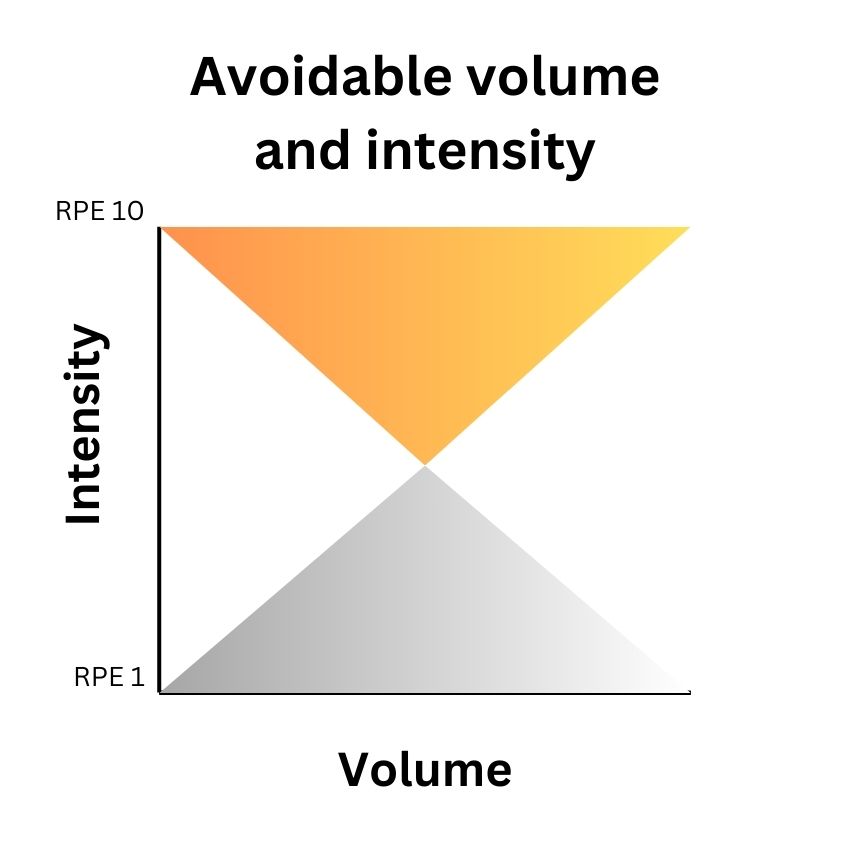
These two scenarios are avoidable because they’re quite easy to fix with correct education and programming.

Final Thoughts

Understanding the relationship between volume, intensity, and density can help you make those gains you want so much. You want to train hard and often enough to stimulate your muscles and nervous system but not so hard that you get hurt. You also want to ensure that you’re doing exercise at a high enough volume and intensity to make any gains at all.

These variables are changeable for the individual and individual goals, so take the time to learn and enjoy the process of getting fitter and stronger.  

Written by Gary Dunn a.k.a. @geekphysique_za
Can’t find a deadlift bar? Try these 10 alternatives

Conventional Deadlift

Deadlifts are often acknowledged as one of the primary lifts for strength or hamstring, glute, and back development. Being able to lift a heavy load off the floor is also one of the ultimate tests of strength, but what if there are no barbells available or you want to change things up for a while due to an injury or general training plateau? It’s great to change things up once in a while and if you’re set on doing a deadlift-style exercise, there are various options for you.

Conventional deadlift

First, let’s consider the conventional deadlift form. Even though cues will vary depending on the coach and individual, there are some basics to remember:

  1. Feet: Hip width apart and toes pointing almost straight forward.
  2. Shins: The Bar should be just over the midfoot and when grabbing the bar, should be pulled against the shins.
  3. Grip: Hands should be just wider than the feet at shoulder width. (Knees and thighs should push against the inside of the arms)
  4. Back:  Lock your back in slight extension (lumbar and thoracic).
  5. Brace: Breathe into your abdomen and push your stomach, obliques, and back outward as if you’re about to get punched in the gut. If you have a belt, all sides should feel pressure.
  6. Shoulders: “Set” the shoulders and position the shoulder joint right over the hands.
  7. Shoulders > Hips > Knees: Shoulders are higher than the hips and the hips are higher than the knees.
  8. Drive through the feet and push your hips towards the bar as you pull it off of the floor. (Hips should not rise above the shoulders early).

The deadlift is a full-body exercise but it does emphasise the hamstrings, glutes, and erector spinae muscles of the back. Accessory muscles will include the quads and upper back muscles.

Non-barbell deadlift alternatives (heavy)

Trap bar deadlifts

What if you can’t find a barbell for deadlifts or you just want an alternative for a new training block? There are some non-barbell alternatives when you still want to lift heavier weights with a similar form pattern to conventional deadlifts. However, not all gyms will have these pieces of equipment.

Belt squat machine deadlifts:

Another piece of specialized equipment that has become more popular. Grab a wide-grip lat pulldown handle and attach it in place of the belt. This deadlift variation will often work similarly to the deficit deadlift due to the depth possible with most brands. You’ll also be able to have constant tension at a greater range of motion before reaching the bottom.

Just doing belt squats are also a great alternative for building leg size and strength, especially if you can’t overload your spine with a heavy barbell.

Non-barbell deadlift alternatives (light):

What if you want some of the benefits of deadlifts without needing to lift heavy? These alternatives are great for the general gym-goer, those with injuries, or if you just want a movement-specific warm-up before doing heavy deadlifts.

Kettlebell or Dumbbell deadlift

For many, the barbells are often in an area of the gym they want to avoid or they don’t have a barbell at home. Some people also just started training, so want an accessible piece of equipment to do lots of reps with. You can use either a narrower stance with the weights by your side for more quad engagement similar to a trap bar or have a wider (sumo) stance with the weight in front for more glute activation. This variation is also great for getting a full range of motion similar to creating a deficit.

Credit: Onnit

Single-leg deadlift

If you’re training at home with lighter weights or want to target your hamstrings and glutes even more, single-leg deadlifts are great. By focusing on one leg at a time, you can use less weight and target one leg more effectively. This variation is also great for learning to keep your hips more stable as you hinge forward.

Don’t be afraid to lightly hold onto something for balance because you want to target the muscles and not worry about falling over.

Bulgarian split-squats

Everybody’s favourite exercise is here, right? Not only is this a perfect exercise for developing the legs, but it can also help you with improving other exercises. Even with lighter weights, Bulgarian split squats can make the legs work very hard, but it is important to work past the discomfort. If you use a full range of motion, you’ll work the entire posterior chain as well as the quads in front.

The leg drive on the front leg helps you activate as many muscles as possible while also improving the strength and mobility of the hip flexors on the back leg.

It’s also great as a warm-up or potentiation exercise for a heavy deadlift workout.

Credit: Squat University

Non-conventional deadlift with barbell

What if you had a barbell but you wanted to change things up a little bit? The conventional deadlift is great but people often have “sticking points” in different areas of the lift or just want to directly target different muscles.

Sumo deadlift

The step-child of all deadlift variations, the sumo deadlift is still top of many lists. It is also allowed in most powerlifting federations. But, why would you want to try out this variation?

Due to the wider stance, you are using even more of your hamstrings and glutes to lift the weight. If perfected, you could lift more weight than you would doing a conventional lift. There are some pros and cons though:

  • Even though you’re targeting the posterior chain even more, the range of motion is reduced, meaning that muscle growth is hindered. A fuller range of motion has been scientifically shown to provide more muscle growth.
  • It’s useful for lifters with long femurs (thighs).
  • Potentially more reps at heavier weights.
  • Most people in the gym will judge you for lifting sumo.

Stiff-leg deadlift

Do you want to target your hamstrings even more? As we know, muscles get their best growth stimulus in the lengthened position. Doing stiff-leg deadlifts or Romanian deadlifts (RDLs) are a great way to target the hamstrings. However, stiff-leg deadlifts are better for power generation than they are for pure muscle growth.

With this variation, the exercise starts from the floor like a regular deadlift. You want to have your knees bent very slightly but your hips high and your shoulders ahead of the bar. Hips should still be pushed as far back as possible with the hamstrings stretched. Generate power from the floor, but keep the bar close to your body and hinge at your hips instead of the knees. Remember, you won’t be lifting very heavy and the slow essentric (lowering phase) should still be slow and controlled with shoulders pulled back and chest open.

Romanian deadlift

The technique is almost exactly like the stiff-leg deadlift but the movement starts at the locked-out position. Hinge at the hips and lower the bar as slowly as possible with knees only slightly bending later on. Slow lowering phase and athletic pull back to the top but touching the floor isn’t the goal. Your hamstrings should feel almost all of the stretch and contraction with a slight pause at the bottom.

Credit: Squat University

Deficit deadlift

If your sticking point with the conventional deadlift is getting the initial pull from the floor, you could try adding a deficit. This is where you either stand on a small elevated platform or use smaller plates to get the bar lower.

Having the bar at a lower position forces you to have your hips lower, overload the initial pull position, activate more of your leg muscles like the quads and work past the difficult part of the movement.

Start with just about 5-10cm elevation like standing on some flat bumper plates.

Rack pulls/Box pulls

The opposite of deficit deadlifts, these are often used to help get past the knees. If you struggle to lock out your deadlift, have the bar on the safety pins of the power rack or boxes. The bar is usually just under the knees to help you lift more efficiently at the sticking point.

Where deficit deadlifts are usually lighter, rack pulls tend to work better at a heavier weight. You’ll be activating more of your hips, glutes, and back muscles here. The range of motion is very short, so it’s not advised for muscle building, but an accessory for power and deadlift strength.

Be aware, that dropping the bar in a rack will potentially be a bad idea for keeping your bar in good shape. Having the weight rest on boxes is a better idea. However, rack pulls will have no slack in the bar, and box pulls will, like a regular deadlift.

Which should you choose?

The deadlift might be one of the best tests of true strength but not everybody needs to lift anything near maximal weights. If you’re not competing in a sport that tests the deadlift directly or you just want to be as strong as possible, you don’t need to do them.

Any of the other variations like RDLs, kettlebell deadlifts, Bulgarian split squats, and others mentioned above are perfect for muscle building and still increasing strength. It will all depend on your goals and ability to perform the movement most effectively.

Written by Gary Dunn (@geekphysique_za)

Should you always keep your muscles guessing in your workouts?

Don't keep muscles guessing by always changing workouts

If you’re joining a gym, training group, or working out at home, the idea is usually to progress and get better. Some people will progress faster than others and those who don’t progress as quickly want to know how they can speed up the process. One of the myths you might hear is that you always need to keep your body or muscles guessing by doing different exercises each week and workout so that you don’t plateau or get bored. Unfortunately, that’s not how the body works and whether you’re a beginner or an advanced lifter, consistency is the best way to get results.

There are many ways you can write or follow programs to help you get your results but there’s just so much of it to sift through. Here are four simple tips on how you can keep progressing in your fitness journey without chopping and changing workouts and exercises each time.

Progressive overload

The term progressive overload means that you keep increasing the volume or intensity each week or workout so that you can make small improvements each time. This is the better way of keeping your muscles “guessing” or in this case, stimulated so that you keep improving. The slight increase in weight, reps, or sets with the addition of rest time manipulation can stimulate your muscles to keep progressing.

Well-written programs with progressive overload are easy to track because you’ve got specific variables that are changing, so you know when you’re getting stronger, faster, or fitter. You want to keep a consistent stimulus between periods of recovery while tracking the improvements.

For example: If you keep changing your exercises for leg day, you can’t keep progressively overloading your muscles because you keep starting from scratch by doing a different exercise. Without a plan on how to progress those important volume and intensity variables, you’ll find it difficult to improve.

Training cycles

Now that we know you need a good program, how do you make sure that you’re constantly progressing without burning out? In simple terms, every good program is defined by training cycles. These are divided into macro-, meso- and microcycles. These are the periods of training defined by your goals, ensuring that you’ve got periods of progressive overload and periods of deloading, or recovery. Macrocycles define the longer periods to reach a goal, like losing a certain amount of weight in three months. Mesocycles are shorter periods of progressive overload and recovery, taking about four to eight weeks. Microcycles are your weekly routines defined by individual workouts.

Depending on your goals or training ability, these cycles, especially mesocycles will look very different. For those who are brand new to training and exercise, these training cycles can take a lot longer because their bodies adapt but also recover much faster, especially for the younger population. Intermediate and advanced athletes might have a four-week mesocycle with three weeks of overload and a week of deload because they tend to push their bodies much harder and need more recovery.

A good program will include well-defined mesocycle blocks within a larger macrocycle (e.g. 12-week transformation program) which ensures that you’re always progressing. You should still be doing the same exercises but with more reps, sets, or weight, or a combination of the three followed by a period of less load to ensure that you’re progressing and recovering effectively.

Keep the exercises the same during a mesocycle and track their progress instead of chopping and changing every week.

Consider stimulus vs fatigue

Stimulus to fatigue is a term popularized by Dr. Mike Israetel, a bodybuilder with a Ph.D. in Sport Physiology. Exercise is used to create a stimulus that will drive adaptation and performance but it will cause a certain amount of fatigue. Your goal is to get the most stimulus out of exercise without causing so much fatigue that you can’t recover before training again.

The relationship between these two variables is very important for progressing in your fitness journey. The better the stimulus, the more you will progress. However, if the stimulus causes so much fatigue that you can’t recover before your next training session, your progress will be negatively impacted. You also don’t want to have so little stimulus that you’re not driving any fatigue or adaptation. Fatigue is an important part of the process. You can look at this relationship from the perspective of the whole workout or even individual exercises.

Depending on your goals and training split, you want to recover from your overall workout by the time you reach that same workout or muscle group again. If you had an intense leg workout consisting of squats and accessories that fatigue the hamstrings, glutes and quads, you won’t be doing deadlifts for a couple of days. Both the squat and deadlift train large muscle groups but also fatigue the central nervous system in a big way.

You don’t just want to recover from your workouts, but you want exercises that have a great stimulus that causes a good amount of fatigue but not so much that you can’t continue the workout or recover before the next one. If you want to grow your legs, it might be tricky to continue the workout after many heavy squats, but if you had leg press or hack squats as your main multi-joint compound exercise, you have enough energy left to do more high-quality accessory exercises in the rest of the workout.

If you’re writing your program or talking to your coach, learning which exercises cause a good amount of stimulus with a good amount but not too much fatigue, you can find the exercises and workout split that gets you the best results.

This concept is at time complicated yet also simple, and can be expanded on in a much larger article, but not today.

Limit confusion

We only have so much time in the day to work out. If you don’t have a program that tells you exactly what to do, you can get confused and waste time. If you’re starting a good program, you can start lighter and get the hang of specific exercises. By the time you get to the last week of the mesocycle, you can push harder in the exercise to drive more stimulus into the muscle and recover effectively. If you’ve got a new exercise for the same workouts each time, you’ll be wasting time looking for new equipment you’re not used to using, learning the ropes, and not going heavy or intensely enough to drive that important stimulus.

All of this confusion will also cause frustration, making it less effective and you probably won’t stick to it after not seeing any results.

A well-written program with similar exercises in a mesocycle will provide you with a better stimulus-to-fatigue ratio while driving progressive overload. If you stay consistent with these important variables, you’ll have a better chance of getting the progress you’ve been working for.

6 Tips to help you improve your barbell squat

Tips on how to squat more effectively

Whether you start sport as a kid or enter the gym as an adult, you’re introduced to important exercises that stand above the rest. If it’s not doing push-ups or pull-ups, you’re told to do squats to improve your leg strength and size. Now, you should always start with bodyweight squats, but what’s next? When you start getting better, you get introduced to the barbell squat, but in many ways, it’s a different exercise. Novice lifters have so much information thrown at them from the start that they don’t particularly know where to begin in the first place. Even though there are many squat variations out there, we want to focus on the popular barbell squat.

Here are 6 areas of focus that will help you improve your barbell squat:

High-bar vs Low-bar Squat

High-bar and low-bar position squats are both legitimate ways of doing the movement, but it might just depend on your goals when choosing which one to use. It often comes down to more athletic sports like weightlifting and powerlifting, or if you’re focusing on muscle building and bodybuilding.

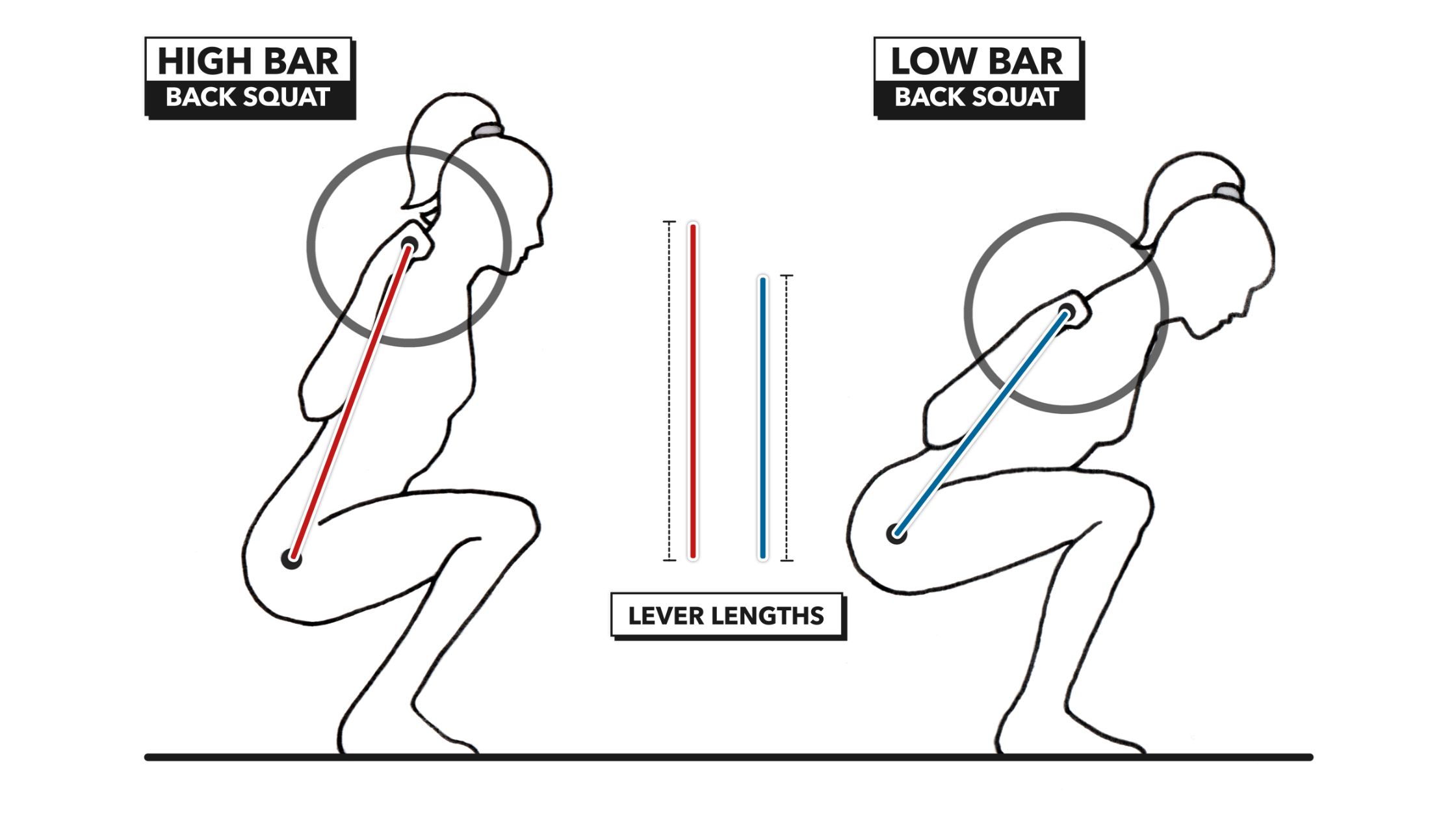
High-bar squat: The most common variation of the barbell squat, it is recognised by a bar sitting more on the traps just below the neck. Also, you will have a more upright torso, lower hips, and shoulder-width stance position. This variation has you squatting “ass to grass”, ensuring you’ve got a deep stretch in your quads, maximising muscle growth.

Because you’re resting the bar on your shoulders, you’re not using your arms to hold it up as much. The weight is lighter but you’re able to get more full range of motion reps without taxing your lower back. Other than being perfect for bodybuilders looking for big quads, the low bar squat is often used for more movement-intensive sports like Olympic lifting and sprinting.

High-bar vs Low-bar Squat

Low-bar squat: The low-bar squat is a more niche movement. It is often used by strongmen and powerlifters due to the ability to generate more strength from their squats. The bar position is on the posterior deltoids and spine of the scapula. It naturally gives the athlete a more horizontal torso position, hips pushed further back, and a wider stance. The movement generates more force from the posterior chain in the hamstrings and glute muscles but also has less strain on the knees due to the angle they are at the bottom of the movement as seen in this study from 1996.

If your goal is pure strength and power, like powerlifting, the low-bar squat is for you.

You can utilize both of these movements during a training program, but you have to choose which to use more often depending on your goals.

Elbow & Hand position

The position of your elbows and hands will link directly to the bar position you use during your squat. It also comes down to flexibility and mobility. Strongmen and powerlifters who use the low bar squat can be less mobile in their shoulders than other, more mobile athletes, purely due to their competitive events. So, during the set-up of the squat, their hands will be further apart to be able to get the bar into the lower position. However, their elbows will still be tucked in and under the bar as much as possible for stability.

When doing the high bar squat, it is easier to set up the elbows right underneath the bar, tucked into the lats with a narrower hand position. Athletes will find this position much easier to get into due to shoulder mobility and wider range of motion.

The walk-out

You want to stay as stable as possible when doing your squats. Taking too many steps out of the rack not only wastes energy but will destabelize the barbell on your shoulders and can hinder your brace.  When you’re about to lift an exceptionally heavier weight, you want to have confidence in your balance.

You want to take two large steps out of the rack. You can also do two and a half steps to adjust your stance if needed. This ensures efficiency and optimal balance for lifting.

Squat stance

Dialing in your squat is a process of trial and error, and the position of your feet is one of those tough decisions to make. The most basic thing to remember is that you want your thighs to follow the angle of your toes, but this can also change in some cases. It’s all about comfort in the ankles and hips. Here are 3 things you can do to help you get the right stance.

  • Your feet are flat on the floor.
  • Your hips are comfortable, i.e. no pinching or pressure). Find a position in which the hips move the most freely.
  • Each thigh is approximately parallel with the corresponding foot, if you look straight down from above one thigh, your foot is in line with it.
Woman doing squats with wide stance on white background
Finding your preferred squat stance is all about trial and error.

However, this can also change according to the type of squat you’re doing. Often, the lower the bar position, the wider the foot stance due to the more horizontal torso position to give more space. The wider foot position also helps with the leg drive which is activated by the more pronounced hip angle.

Squat speed

In recent years it has been studied and corroborated that using the slow essentric phase of the movement has the best stimulus for muscle growth. Slowing down the lowering phase of your squat and going as low as possible not only stretches your targeted muscles like the quads but increases time under tension. These factors can help you build bigger and stronger muscles with your squats.

Powerlifters on the other hand will lower themselves more quickly into the squat to use the rebound from their knees and hips to force themselves back up. However, moving too quickly can hinder strength and power.

The Force/Velocity relationship is a straightforward method of showing how two variables impact each other, and in this case, your squat speed versus power output. If you want to know more, you can check out this link here for more details. In short, it shows that the more speed you have, the less force you can generate in your squat. You don’t want to drop down into the squat so quickly that you lose balance or power in the second phase.

Squat depth

When doing the squat, the goal should always be to go as low as possible. Exceptions to the rule will be those who are brand new to the movement, those with an injury, or somebody with a disability that doesn’t allow them to go low enough. Getting a squat as low as possible is going to be much easier with the high-bar squat position.

With your foot position sorted, bracing correctly and a slow lowering phase, you want to squat so low that your hamstrings touch your calves if possible. It might take longer for some to get into this position with their back staying neutral and hips feeling comfortable, but progression is the aim of the day.

While doing full range of motion squats should be the goal for most people, especially starting or building the most muscle, there are exceptions. If you’re working towards power and doing the low bar squat in competition, the goal is to only have your hip crease below your knee cap.

These six tips to maximise your squat are mere suggestions but they provide a great starting point for those just starting. If you’re a more intermediate athlete, this might be the baseline to revert to if your squat isn’t progressing as much as you would like.

Improve your bench press with these helpful accessory exercises

Bench press accessories can boost your lifting potential

Whether you’re new to the gym or an intermediate to advanced lifter, you probably want a big bench press. However, with everybody having a different body shape and coaches having different approaches with loads of content out there, it can be hard to sift through it all. All of this content usually just tells you what the issue might be and how to fix it, but only when you’re already on the bench. 

Did you know that accessory exercises are more than just workout fillers? When building a program for something like the bench press, it’s not enough just to add movements after the main lift for the sake of it, but accessorise your program with movements that help you lift better. 

Here are seven sticking points and an accessory or two for each to help you get a bigger bench: 

Accessory exercises to improve your bench press

Accessory movements are those exercises that should help you stay injury-free but also help you get stronger. Getting stronger doesn’t mean that they need to be heavy or super high volume, but can be as simple as adding it to your warm-up.

Plant/Root your feet

When lifting, especially when lifting heavy, you want to be as stable as possible. A better bench press starts with good foot placement and making sure they’re not all over the place when pressing. Unless you’re doing Larson presses, you want your feet rooted to the floor. 

Because you’re about to drive with your legs, having your feet under your hips as much as possible is a great place to start. Make sure your heel and toes are planted to keep you connected and stable. 

Accessory Exercise: Ankle mobility

For most people, getting their feet planted under their hips is hindered by ankle mobility. As a warm-up, grab yourself a plyo box or bench, and place your foot on top as if you’re about to do a step-up. Instead of stepping up, lean forward so that your knee goes over your toes. As your heel lifts off of the bench, lightly force it back down as you breathe through the stretch. Do this for one or two sets of 30 seconds for each leg. 

Leg Drive

Yes, you’ll be using your legs during the bench press. If you have your feet planted, you’re already most of the way there. Using leg drive in the bench press is very different to squat or deadlift. Even though some people drive their hips to the sky like a glute bridge, one of my favourite ways to drive with my legs is to drive them along the floor toward my head and shoulders. 

When competing, you’re not allowed to have your butt lift off of the bench, so driving your hips to your head and shoulders could help. The technique will not only help keep your hips down but drive your traps into the bench and even improve your arch. 

Accessory Exercise: Bulgarian split-squat 

Everybody’s a least favourite exercise in recent times, adding the rear leg elevated split-squats to your warm-up can help you get the feeling of the correct leg drive. Usually, you’re focusing on the leg drive from the front leg to work on the glutes and hamstrings, but focusing on the stretch in the quads and hip flexors on the leg elevated behind you can help with your bench press. 

With the back leg balanced on your toes, drive through the back leg for a couple of reps and sets, teaching you to transfer the force through your body to the bar. 

Bracing

Bracing during any lift not only keeps your spine safe, but because of the tremendous pressure in your abdomen, you’ll be surprised how much more you can lift. 

How to brace

  • To breathe properly take a deep breath through your mouth with minimal chest expansion forcing air into your stomach and holding it, then brace your core muscles as if you are preparing to take a punch in the stomach.
  • Bracing is an all-around feeling, so if you’re tired after a run, place your hands on your obliques and feel them expand as well as your back muscles, expanding your whole trunk. 
  • If you’re an intermediate lifter and start wearing a belt, you need to feel the tension pushing into the belt all around. 

Accessory movement: Planks

Do your elbow planks and side planks. Not only will you learn to brace and hold in the right positions, but you’ll also learn to tense your entire body as part of the core bracing. Don’t just try and keep your body straight but dig your toes into the floor, brace your core, and tighten your shoulders as hard as you can for at least thirty seconds. 

Don’t neglect your abs, even if you’re not exercising for aesthetics.

Elbow position

You want as much of your body under the bar as possible when benching, including the elbows. As an easy rule, you want your elbows at a 45° angle, especially on the lowering phase. This position helps your arms stay connected to your lats, giving keeping that tension you’ve built. If your elbows flair out, you’ll notice an immediate decrease in power. 

Warm-up: Neutral grip dumbbell bench press

Close grip Dumbbell bench press: When lying on the bench with light dumbbells, have your palms facing each other instead of towards your legs. Slowly lowering the weights, imagine your triceps resting on your lats as you get into the full chest stretch. Press up explosively, using your triceps, chest, and lats. 

Accessory exercise: Close-grip bench press

A popular bench accessory where your hands are as narrow as possible (narrower than chest width), lower the bar slowly with your elbows staying close to your body and only press after the bar touches your chest. 

Gripping the bar

As we mentioned before, you want as much of your body under the bar as possible, including your wrists. If your wrist is bent too far back, you lose a lot of the tension and drive you’ve worked on so hard. 

Try placing your hand on the bar and then twisting your thumb into the bar. The bar will mostly be in contact with the padding under your thumb and pinky. Trying to death grip the bar will force your wrist back and put tension on the forearms while you try to focus on pressing.

Accessory Exercise: Finger curls

Hold onto a barbell hanging in front of you. Extend your fingers let the bar drop and curl the bar back up by flexing your fingers. 

The bench press grip is more for control instead of a death grip. 

Bar placement

When lowering the bar, we are often too worried about where exactly it should land. With everybody having different body shapes and arm lengths, there’s a spectrum. If your elbows are at the right angle and you’ve got your grip sorted, the bar will touch your chest where it needs to. A good range is somewhere near your nipple line and mid-to-upper chest. 

Accessory exercise: Inverted row

Inverted rows are a great mid-workout accessory. Setting up a bar in the rack at different heights can help you increase or decrease the difficulty. If your body is straight, even if your knees are bent can help you pull yourself to the bar. Where the bar touches your chest is often going to be where it lands during pressing. It’s also great for strengthening the back muscles in the same position you would be pressing. 

Training frequency

After deadlifts and squats, you often feel like a few days, if not a whole week, is necessary to recover from the workout due to much larger muscle recruitment and weight lifted. Your chest and arms have smaller muscles and the impact on your body is much less. That means that you can recover faster, and can train sooner. It’s time to ditch the “bro-split” and get some more chest training days into your program. 

Depending on how long you’ve been training, adding a second or even third chest workout can benefit you. 

How to increase bench press frequency

You don’t just want to jump into doing 3 bench press days a week. Start with adding an extra day about 2-3 days after your workout, especially if you don’t feel sore anymore. 

A common way to split two bench press days is by adding variations like doing one heavier day of conventional bench press and a lighter close-grip bench later in the week. If you’re just splitting 8 sets of bench presses into two workouts with 4 sets each, the volume isn’t going up and won’t help you. When splitting your workouts, add two working sets to each of them. 

Conclusion

There are many different cues and accessories to add more weight to your bench press. These are just a few easy accessories you can add before or during your workouts to help improve your pressing technique and strength. 

Finding out what works for you is always going to be more important than clear-cut advice, but this is a great place to start.