Should you take a break from whiskey?

Should you take a break from whiskey banner

If you’re here, you enjoy the occasional glass of whiskey; enjoying the flavours, complexity, and company you’re drinking with. But alcohol does have a more uncomfortable side too. It is unfortunately addictive and we have to look after each other.

There are warning signs you should look for but taking a break from the amber spirit also has benefits, even if you don’t have a dependence issue.

Good reasons for taking a whiskey break

While there are many uncomfortable reasons to take a break from whiskey, there are some good ones too.

Reset the palate

We love exploring the complexities of whiskey, finding the flavors that tickle our senses and take us on a journey. However, if you’re drinking whiskey more regularly, you can get a form of flavour-blindness. You start struggling to differentiate between whiskies or find new flavours in new or old bottles.

Taking a break from whisky will also give your palate time to rest and your brain gets a break from searching for something new. You might realize that the first whiskey you pour after a short break will taste like the first time you had it.

Wellness goals

If you’re somebody who enjoys whiskey but wants to lose some weight or become more active, taking a break from drinking is a good idea.

Besides consuming more calories in the form of drinks, having a buzz can also make you eat more, especially more palatable food which usually has many more calories than usual. Alcohol also stunts your metabolism, forcing your body to store fat instead of using carbohydrates for energy.

Give yourself a break until you reach some health goals, and you might appreciate your next pour a lot more.

Going on a trip

When we go on holiday, we want to enjoy ourselves with drinks and delicious food. We want to appreciate what we consume and maybe you’re going on a distillery tour.

Well, just like resetting your palate, taking a break from whiskey for a week or two before a holiday or whiskey tour will help you appreciate the experience you’ll have with family or friends.

Bad reasons for taking a whiskey break

Now, let’s understand the more uncomfortable reasons for taking a whiskey break. As we mentioned, it’s easy to build an alcohol dependence and we need to be vigilant about it. There are warning signs that you might be developing a dependence or addiction that you and the people around you will notice.

Drinking more often

Are you starting to drink more every weekend? Or are you starting to drink earlier in the week? We all understand that life can be stressful, but finding “relaxation” in whiskey is not the healthy route.

Most of us will have a drink or two on the weekend, but if you’re finding yourself wanting a drink earlier in the week, you might want to rethink why you’re having a pour. When you start thinking about what you’re going to drink while still at work or pouring a drink earlier in the day, this is a warning sign that you’re experiencing dependence.

Alcohol does help us relax a bit, but it’s not a healthy way of unwinding on a more regular basis.

Drinking alone more often

We don’t all live with a family or have family members that drink whisky.  

Finding yourself not only drinking more often but drinking alone is a warning sign to be wary of. One of the more fun whiskey experiences is having a drink or two with company, having a chat about the whiskey in the glass, or life in general. But if you’re starting to drink more often with your thoughts, you might want to take note of the frequency.

Drinking earlier in the day

Work is stressful and days are long, but starting to pour a drink to relax earlier in the day could be a warning sign for dependence. Maybe you’re pouring a drink as soon as you get home or you have “desk whiskey” at work, you might want to start setting some ground rules for when you’re having a drink.

It’s hard to stop

Most of us enjoy having some whiskies with friends, but what if you just want to keep the party going?

If you’re starting to drink more as everybody else slows down, you might want to rethink your drinking habits. Some people can have one drink and let it go but if you have to have another and somebody slows you down, you might need to take a break.

Financial burden

We all love being on the whiskey journey. We buy new bottles to explore and have some regular favourites we always want on the shelf. However, it’s not the cheapest hobby to have.

If you’re tarting to have less in the bank at the end of the month or the shelf is getting a bit small for your bottles, start rethinking the hobby.  Take a break from buying anything for a while, slowly going through what you already own.

Set yourself a budget, be it for the whole month or what you’re spending per bottle. There are apps to help you track the number of bottles you’re buying and how often you finish them.

Comments from loved ones

The people around you care about your well-being. They notice your habits and how you act towards others.  Whiskey has a way of changing our mood but alcohol affects us all differently.

If your loved ones are commenting and hinting at your mood when you’re drinking or telling you to slow down, you should listen to them. Maybe your spouse or friends are commenting on the number of bottles you’re buying, worrying about the financial burden. They care about your well-being and want you to be happy, so listen to their advice and start taking a break or looking for help.

How to take a break

Whether you need to take a break or not, it’s important to set some goals where you actively take a break. The length of time will depend on how you feel during and at the end.

A quarterly dry week

Some whiskey communities have a quarterly Dry Week. Every three months, taking a week off from drinking any alcohol can help reset your palette but also give you time to reflect on how often you usually have a drink.

Dry month

Some people take off from drinking in January, labeling it as Dry January. January is when everybody sets New Year’s resolutions, giving themselves time to reflect on their health, going to the gym more often, and just taking care of themselves. It’s the perfect time to refresh after the holidays and reflect on your relationship with alcohol. January is also a long month financially because most of us get paid earlier in December before the holidays.

A good way to figure out if the break is long enough is when you’re not thinking of drinking anymore. If you’re still craving a drink after a month, you might want to look for some help. For others, the month of January is just enough time to start feeling great from being more active and not drinking at all. That is fine too.

Do you need help?

A week should be enough for most people to reflect and reset but if you’re finding that challenging, you might need some help. If you’re taking on the Dry January challenge or something similar, take note of how you feel during the day and how often you think about alcohol. If you write them down and find a trend, ask for help.

Where can you find help?

AA: Almost every country has some form of alcoholics anonymous group to help you reevaluate your relationship with alcohol.

Addiction clinics: There are clinics and retreats for those who want to deal with addiction. If you’re able, you can join them voluntarily. If you’re being sent there by your family or something like a court system, you should know how serious it is and agree to find help.

Community groups: Whether you find a group through official institutions or via social media, there’s always a group of people near you set up to talk about a potential or official dependence. These groups can be run by counselors and professionals who are there to help you recover.

Therapy: Have you or loved ones noticed your alcohol dependence? If you agree, finding yourself a therapist to help is an important step towards recovery.

Enjoy the break

The whiskey journey is fun especially when you’re part of a community that enjoys exploring whiskey to its finest details. However, there are warning signs for when it potentially becomes a problem.

Enjoy your whisky but take some planned breaks to rest and reset. If you see any of the warning signs, there’s always help available.

7 Whisky glasses you should know about

Are you choosing the right whisky glass

Whisky may have originated from the British Isles, mostly Ireland and Scotland but it is an iconic spirit enjoyed around the globe. Because whisky is now made and enjoyed so widely, everybody has their favourite style and way of drinking it. One of the most basic but important choices people will make is the glass they’re drinking from.

Each whiskey glass has its own story and everybody has a reason for drinking out of their preferred glass. There are many types of glassware to drink whisky out of but you could narrow it down to seven basic shapes.

The Rocks Glass

Also known as the tumbler or lowball glass, this is the one most casual whisky drinkers will know about.

The rocks glass originates from Ireland and Scotland where whisky was originally made but they weren’t made from glass. Alcohol was drunk from a quaich “quake” which was more of a drinking bowl with handles on the sides.

High-class individuals used to engrave their glasses with their family crests which is still done today. This trend is still popular with all kinds of brand engravings and beautiful imageg, no matter the material they’re made of.

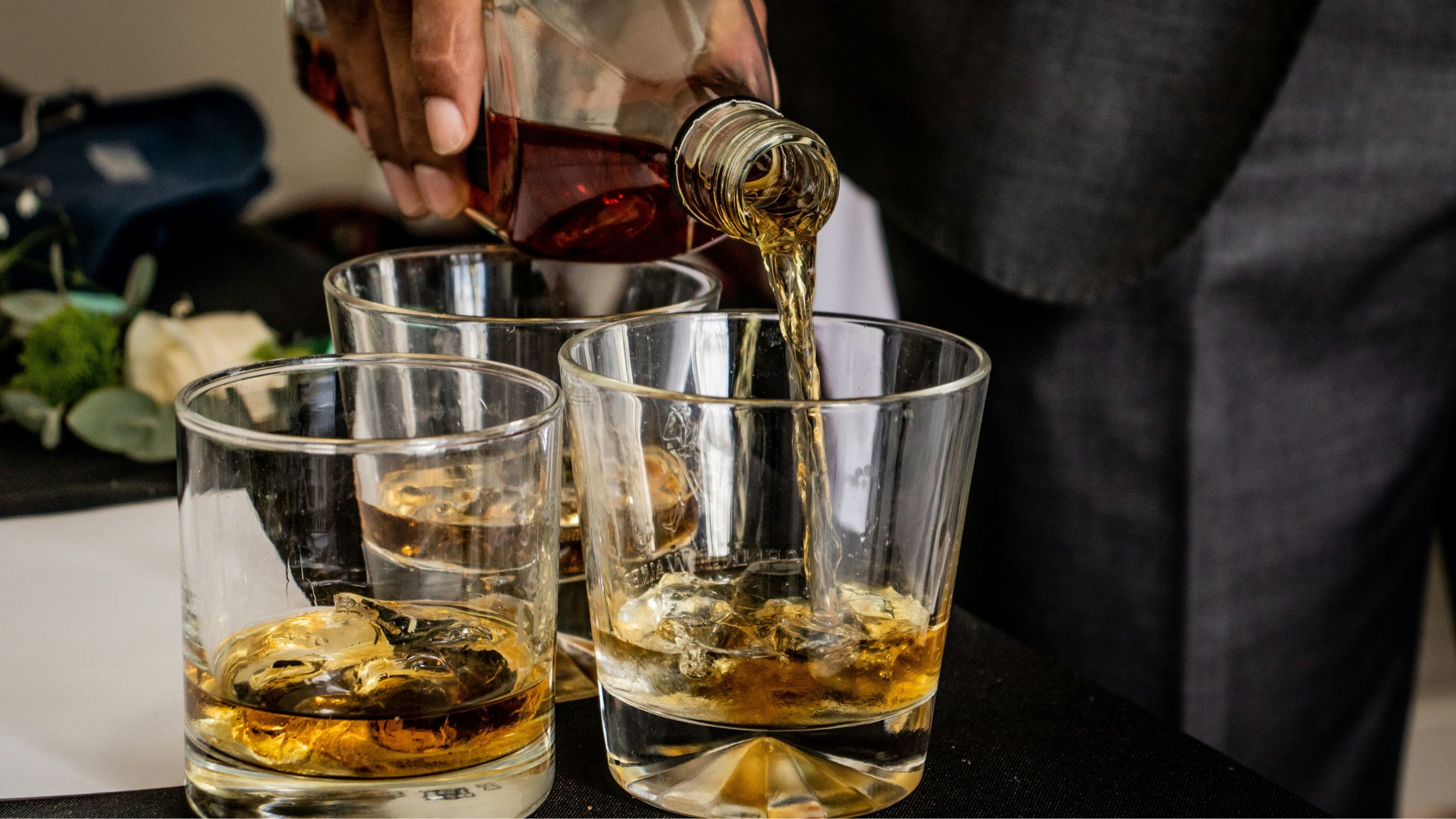
whisky being poured into a rocks glass with ice
Do you like having your whisky on the rocks?

The rocks glass is named as such because it’s one of the best glasses to enjoy your whiskey with one or a few blocks of ice. It’s also short and flat, which makes it look like there’s more in the glass which is more appealing. It’s also not going to be knocked over. It’s also called an “Old Fashioned” glass because it’s used to make the classic cocktail which has few ingredients but makes the glass look full and the drink appetizing.

The tumbler is seen as a high-end but inexpensive whisky glass, making it the perfect all-rounder, no matter your financial situation.

The Highball glass

The tall rocks glass, the highball has its origins in the USA on trains and at golf clubs. It may still have originated from Irish settlers.  The highball is a tall rocks glass but they can be narrow, wide, very tall and shorter.

This glass is more commonly used from all kinds of cocktails, especially when more ice and mixer is included. The layers of ingredients and garnish shine with this style of glass.

Highball glass whisky cocktail
Do you like your whisky as part of a tall cocktail?

Here are 6 more things you didn’t know about whiskey

Bulbed glasses

If you want to drink your whisky neat, a bulbed glass is going to be your best bet. These styles of glasses were originally used by spirit makers, especially whiskey. This is because the bulb at the bottom of the glass captures the aromas in the middle and most of the alcohol harshness is pushed to the edges. The aromas are then funneled to the top of the glass and opens at the top. This is where you’ll spend your time smelling the whisky, exploring each aroma and finding the notes that tickle your fancy.

The Glencairn

The Glencairn was developed in the 1980s by whisky makers in Scotland and is based on the nosing cupita.

The glass has the classic bulb shape and opens slightly at the top to help you smell and capture the aromas. It has a short stem used to hold the glass so that your hands don’t warm the liquid too much.

The Belvenie whisky barrel and Glencairns
Do you like a neat pour of whisky in the classic Glencairn?

Whenever you see whisky enthusiasts and connoisseurs enjoying whisky, this is going to be the most popular glass.

Canadian Glencairn

Similar to the original Glencairn made by Glencairn Crystal Ltd, the Canadian Glencairn is often slightly smaller and has no stem but a thicker bottom.

Whisky poured into Canadian glencairn glasses
Do you like a stemless Canadian Glencairn to explore your whisky?

The Cupita

The cupita, also known as a “shooner”, snifter or sherry glass is made for aromatic alcoholic beverages, such as sherry, port, aperitifs, and liqueurs. It looks very similar to a Glencairn but with a longer stem, similar to a champaign or wine glass.

The bulb shape can also look very similar to a Glencairn but can often be narrower.

This glass is most widely used by whisky makers due to the aromas being captured in the middle of the glass and pushed to the top for inspection.

Cupita glass with whisky
The old-school cupita looks great and is still used by whisky makers.

These bulbed glasses can be made relatively cheaply with ordinary glass or from more expensive crystal with various different shapes and decorations.

The Snifter

The snifter looks like a Glencairn and a whine glass had a baby. It’s got a short stem with a wide bottom. The bulb is short and wide giving more space for the aromas to meld together.

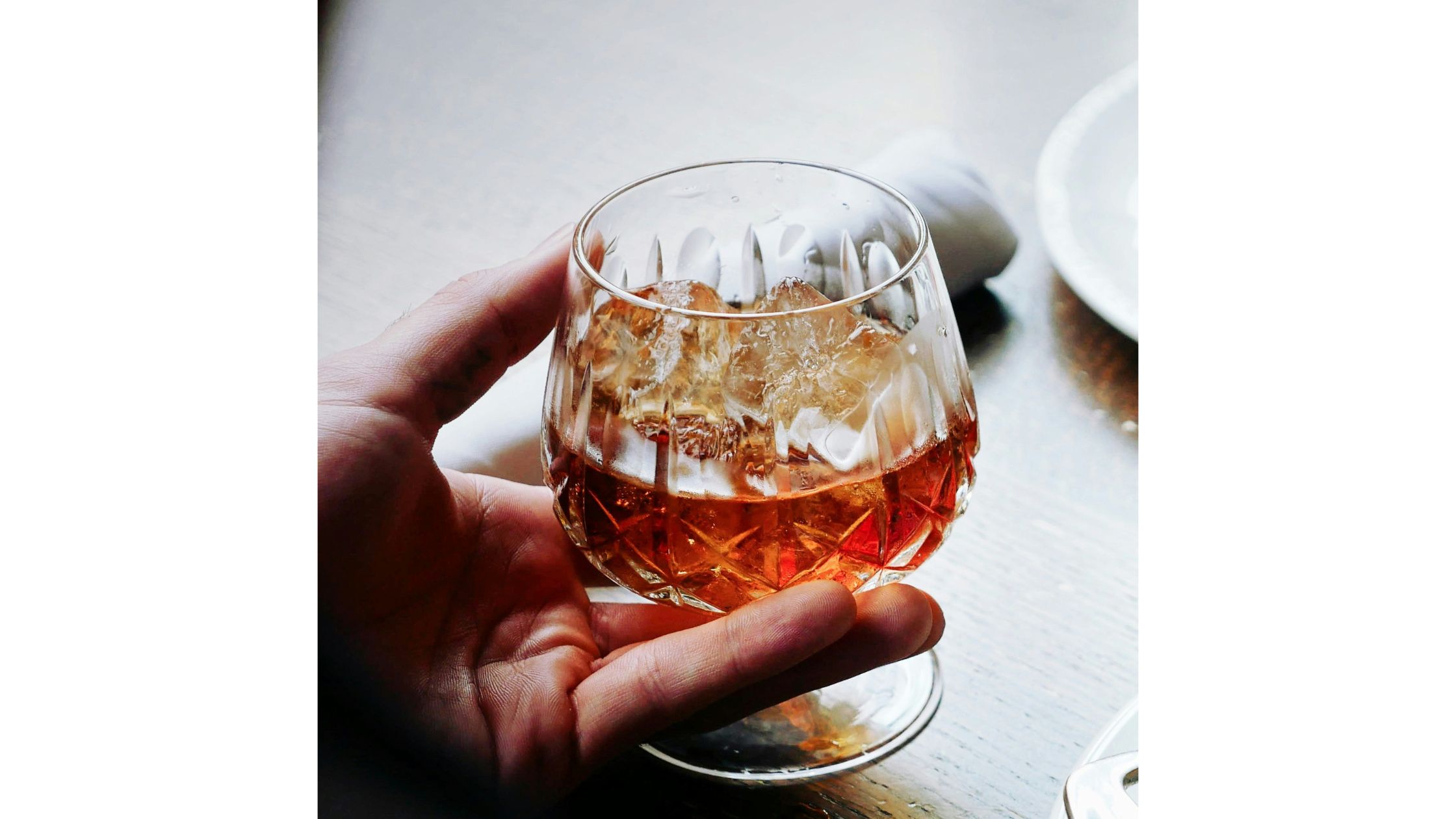
A cognac glass is also perfect for whisky
Let’s get super fancy with some crystal snifter glasses

The glass comes in smaller shapes but a larger version will look like a classic Cognac glass. They are also often made with more expensive crystal and beautiful shapes.

It’s another glass that’s perfect for neat pours but looks even fancier.

The Neat Glass

The neat glass is a very short bulbed glass but usually only has space for a single pour of whisky. The bulb is very short with the rim opening up relatively wide. It looks like a Glencairn was almost flattened. 

It’s a short glass that is perfect for tastings because they’re easy to measure small pours while having all of the benefits of the bulbed shapes like a Glencairn.

Whether you like your whisky neat, on the rocks or as part of a cocktail, your choice of glass will make a big difference.
Do you like it neat or on the rocks?

Do you spell it as whisky or whiskey? Read HERE!

Which glass is for you?

The first rule of whisky is that the best whisky is the whisky you like to drink, the way you like to drink it, as per the Whiskey Tribe. It means you should enjoy the whisky you like, whether it’s in a different glass, on ice or with mixers like cocktails.

If you are looking for a more casual drinking vessel that’s not just great for different pours but looks great and feels comfortable in your hands, it’s the rocks glass. If you prefer cocktails, you might like a coup glass or the highball.

When you want to enjoy whisky in its purist form, exploring the aromas and flavours, and maybe adding a drop of water, you would probably prefer the Glencairn variations, cupita and snifter glasses.

Enjoy your favourite whisky in your preferred glass and it’s always best enjoyed with great company.

How to taste your new and favourite whiskey

Friends drinking and tasting Wheel Horse Bourbon in different glasses

Whiskey is more than just a distilled and aged spirit; Distillers and their blenders put in years of expertise and work into making something unique that will stimulate the senses and give you an experience rather than just another drink. Whiskey makers use various kinds of grains and treat them in unique ways before starting the distillation process. The spirit is then put into specific barrels before being aged for several years and sometimes even moved to a different barrel to add some finishing touches. Then, the distillers and blenders pick barrels to create unique experiences in your glass.

With so many processes and skills going into an expression of whiskey, there are hundreds of different aromas and flavours you could find in each glass. There is no right way to enjoy your whiskey but there are ways to maximise your experience when it comes to smelling and tasting as much as possible.

Whether you’re on the journey alone or helping somebody experience whiskey for the first time, these simple tips can help you.

Let’s start with the glassware

Unless you’re making larger cocktails, there are two main glasses used to drink whiskey, the tumbler/rocks glass or Glencairn.

Rocks glass: This short and wide-bottomed glass is perfect for adding a couple of blocks of ice but many whiskey cocktails are also served in these iconic glasses. The flat bottom ensures that ingredients can be muddled and less diluted cocktails fill up the glass, making them look classy.

This is a versatile glass for many occasions but probably not the best when you want to explore the whiskey to its fullest extent.

old fashioned cocktail in rocks glass
The rocks glass or tumbler is perfect for adding ice or making a whiskey cocktail. Photo via Unsplash

The Glencairn: This bell-shaped glass is designed for tasting a distilled spirit. The glass has a very short stem and robust bottom with a wider bowl shape before narrowing and then opening slightly at the top. The bowl shape not only allows some swirling to open up the whiskey but channels aromas towards a narrowed rim.

The Glencairn allows perfect pours, looks classy, and is the perfect vessel for smelling, tasting, and exploring whiskey.

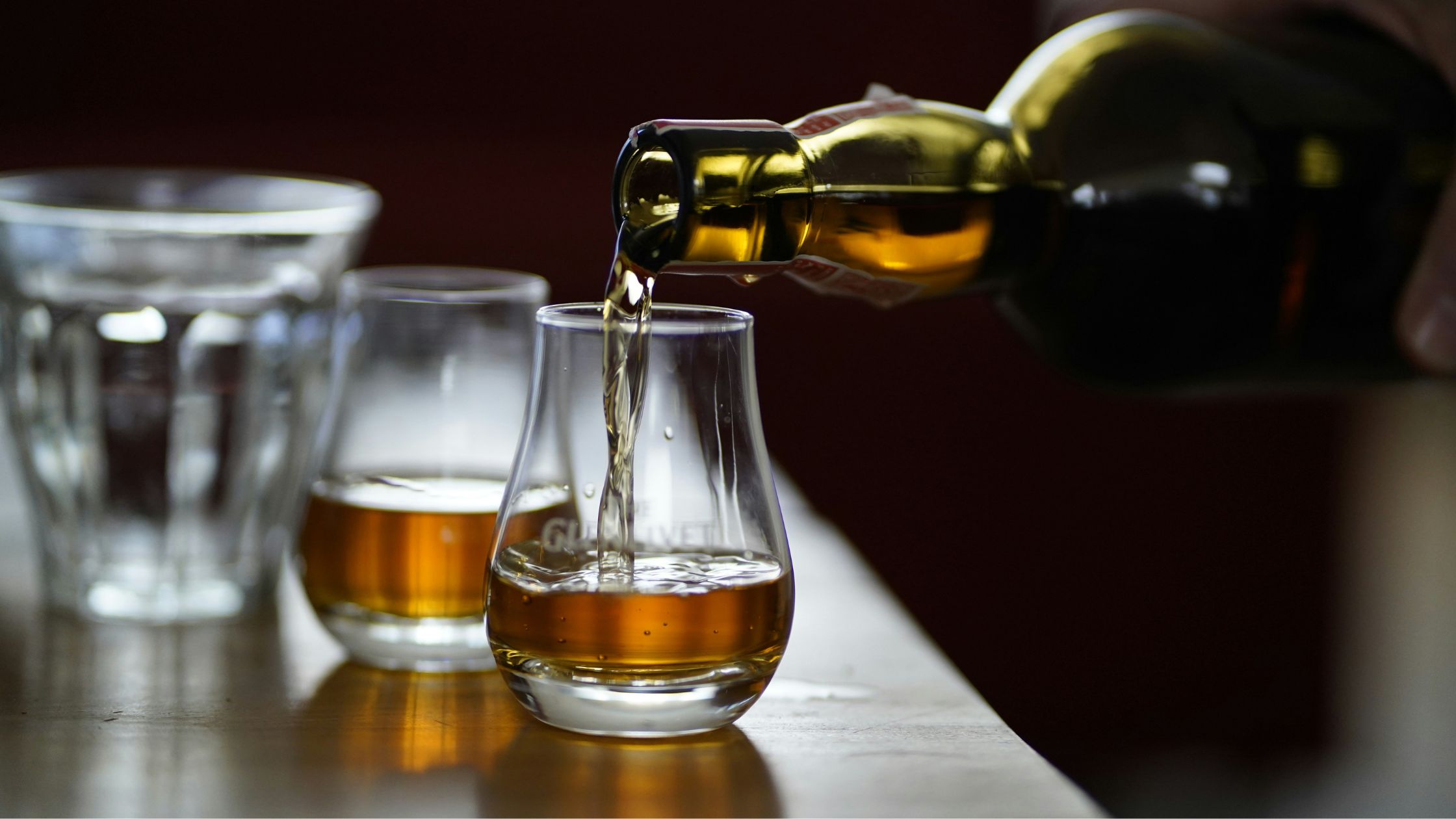
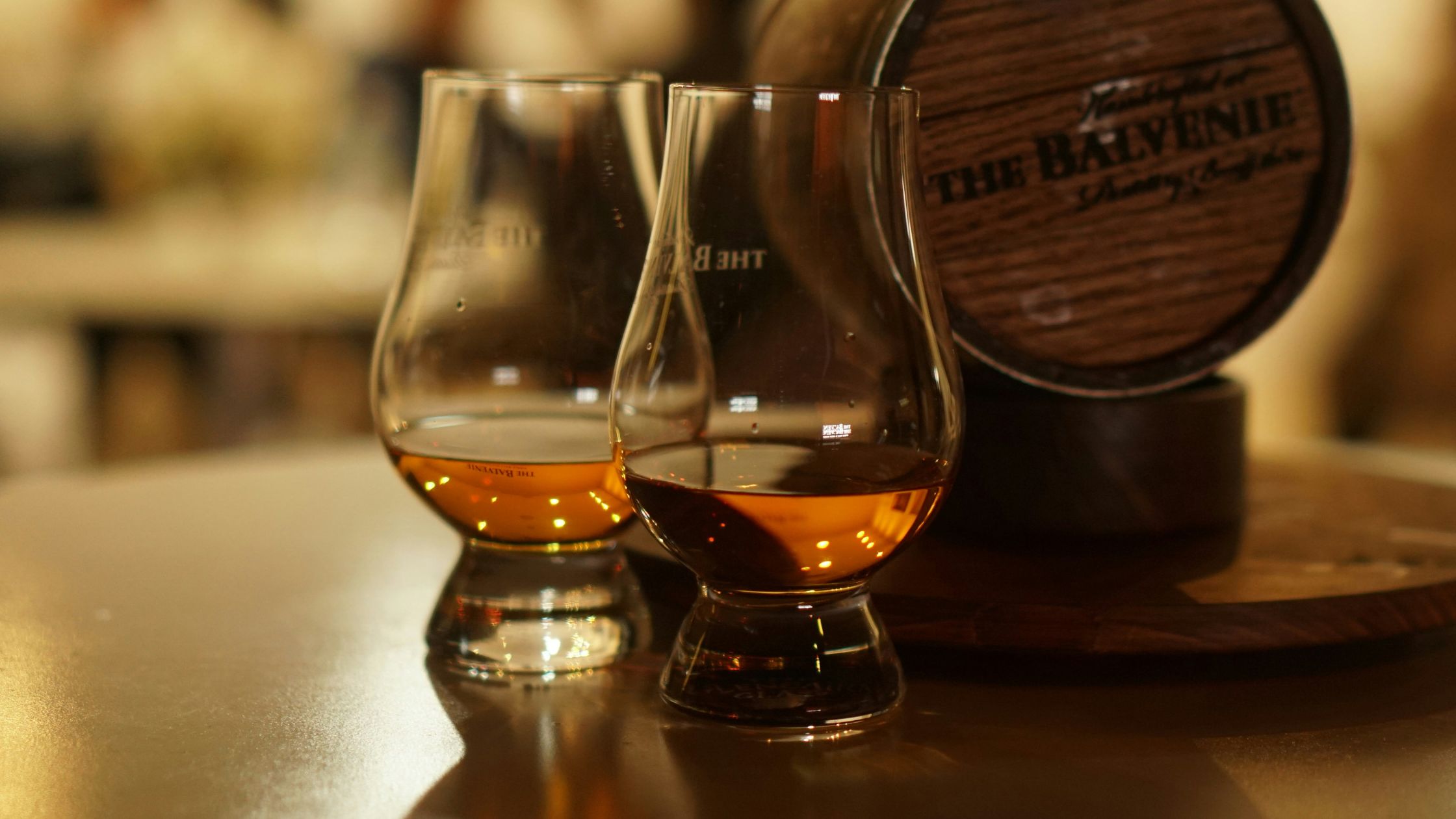
Two Glencairns of whiskey next to a The Belvenie barrel
The Gelencairn glass is perfect for a neat pour of whiskey. Photo via unsplash

Both the rocks glass and the Glencairn come in their own shapes and variations too, all of which can elevate your experiences.

Inspection

This step can seem a bit over the top, but we are often affected by visuals. Whiskies can have vast differences in colour due to casks and climate, so when you’ve got a line-up of whiskies, it can be fun to compare them.

The bowl of the Glaincairn is perfect for seeing the colours at different angles but is also dependent on the time of day or the room that you’re in.

Nosing

Your olfactory sense (sense of smell) is more powerful than taste, so nosing/smelling your whiskey is where you’ll probably spend most of your time. Our sense of smell is also great at finding nostalgic memories to go along with the many aromas you’re about to experience.

First, you might want to think of the ABV or proof of the whiskey. If you’re just starting your whiskey journey, high-proof whiskey might just burn the hairs in your nose and sully the experience. Starting at a lower proof or alcohol percentage will help you experience the whiskey more comfortably.

If you’re new to nosing whiskey, start by holding the glass relatively far away, moving closer. If it starts to burn, just retreat a little bit until it’s more pleasent.

Remember to also keep your mouth open slightly and breathe in through your nose and mouth at the same time. The added oxygen circulation will enhance the experience of the aromas.

It’s not just about the aromas but about the memories they evoke. Whiskey has a way of letting you experience nostalgia, so don’t just think about specific ingredients, but memories. It might be a specific leather chair belonging to your grandfather or gardening with your parents. Spend time with your whiskey and discuss it with those tasting alongside you. You might find that talking about it can help you find notes that you’ve not found before, even if it’s a whiskey you’ve had many times.

Palate

After spending as much time as you need on the nosing, it’s time to taste. One way to not only get flavours but deal with the proof is by dipping very lightly like drinking hot coffee. The addition of air helps you experience what you’ve smelled already (also known as ‘retronasal olfaction’).

However, mouthfeel might be what you experience first as you sip. How does the liquid feels on your tongue and against your very sensitive cheeks? Don’t swirl it at first but let it linger on the tongue. Pay attention to how the whiskey feels in your mouth. Is it soft and creamy or is it direct and spiky? Is it drying or refreshing? These feelings might change to flavours, some of which you’ve smelled, like fruit, types of grass, or a variation of smoke.

Whiskey can develop over time, so don’t rush for another sip but experience, discuss and explore.

The Finish

When you’re ready to swallow, think about the journey. How long can you feel or taste it as it goes down? How long can you sit with the flavour until you’ve experienced how it develops on the palate? Did the experience disappear quickly or can you sit back for a while before needing another sip?

Some final tips

  • Add water: Drops of water not only bring down the proof for those struggling with the “burn” but can highlight different aromas and flavours.
  • Write it down: Write down what you’re smelling, memories you’re experiencing, and notes that you’re tasting. This can help you eliminate what’s already there while finding something new.
  • Smell your elbow: Especially when you’re tasting many different spirits, your senses can get overwhelmed. You’re so used to your smell, that sniffing the inside of your elbow can help reset your senses with a neutral smell.
  • Enjoy with friends: Share your whiskey! Introducing friends to your collection or reminiscing about the memories you share can be a powerful experience. Whiskey is best enjoyed together.
A line-up of different whiskies to be shared with friends
Share and enjoy your whisky with your friends. Photo via Unsplash

There is no RIGHT way to taste whiskey

These helpful tips are not the only way to taste whiskey. You can and should enjoy whiskey in the way that makes it the most comfortable for you. Whether you follow these tips to the letter, add some snack pairings, or combine everything you’ve learned from this and other resources, enjoy the time tasting whiskey.

You don’t even need to agree on how to spell whisk(e)y

Whisky or Whiskey: Are you spelling it correctly?

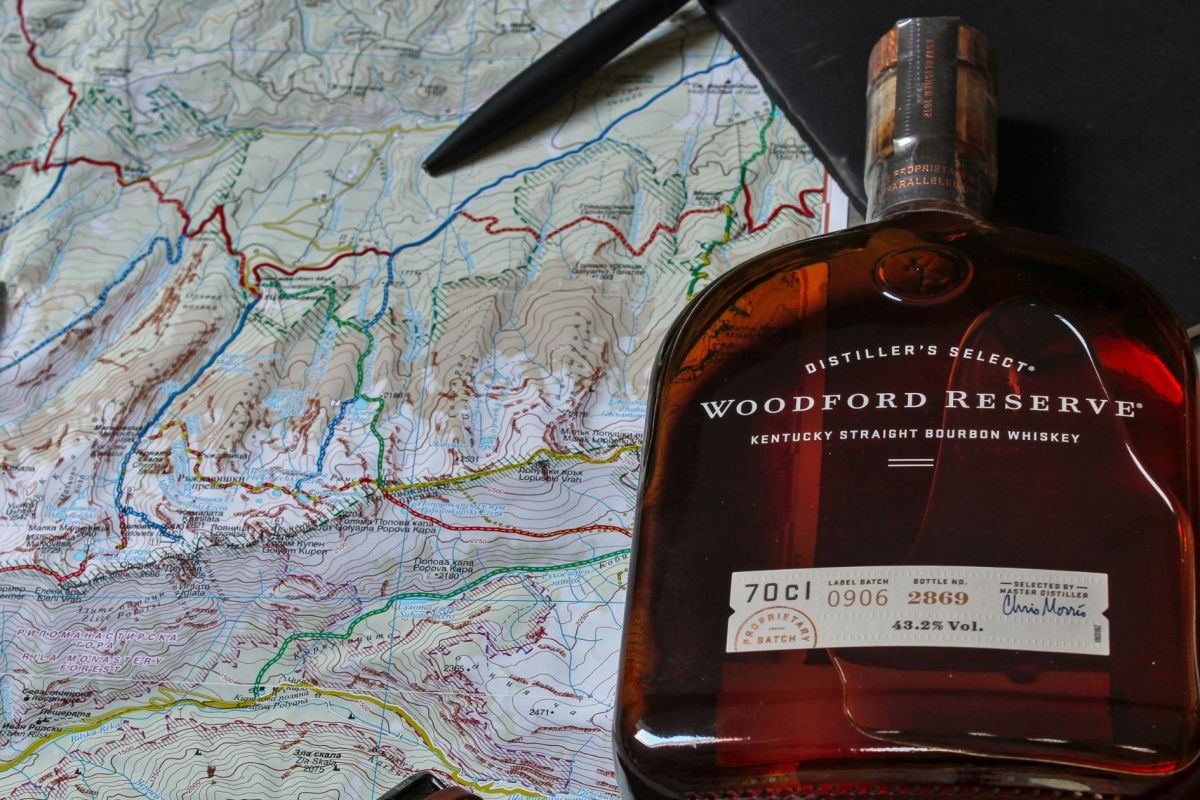
Debunking the whiskey vs whisky debate with Woodford Reserve and a map

The only time we ever argue about the spelling of whisk(e)y, it’s when we read the labels, but does it matter? Even though both of them are essentially a spirit distilled from a variety of grains, their history is intertwined while their essence is enjoyed by people all over the world.

The Irish spelling of whiskey comes from the Gaelic derivations of the word ‘Uisce beatha’, meaning Water of Life. Due to Irish immigration to America in the 18th century, American ‘whiskey’ is also spelled with an “e”. The rest of the world uses the “whisky” spelling, even when they are made similarly.

But, even though whisk(e)y is made in similar ways with similar grains, each part of the world has its variations and rules.

What do whiskey and whisky have in common?

Even though different countries have their versions of whiskey, they do have other similarities.

  • All whiskey has to have a minimum of 40% ABV (alcohol by volume) with some regions having their own rules for the maximum %ABV allowed in the bottle.
  • Whiskey is distilled from barley, wheat, corn, and other cereal grains depending on the type. The single-use or combination depends on the specific whiskey or region.
  • In many cases, the minimum time a whiskey is allowed to mature in a barrel is 3 years before it can be called whisk(e)y.

Irish whiskey

Irish whiskey is very popular around the world as one of the original producers. It’s often experienced as “smoother” than Scottish whisky but is also known as a gateway to bourbon as ex-bourbon casks are often used for maturation.

  • Irish whiskey is usually distilled in pot stills and attributes its “smoothness” to the fact that they’re often distilled three times instead of the usual two.  
  • Whiskey in Ireland has a minimum maturation age of three years in a barrel.
  • Irish whiskey may contain a distillate of malt, a barley distillate, and a portion of grain spirit.
  • Irish whiskey is rarely peated with some small exceptions in the growing industry.

Scottish (Scotch) whisky

Scotch whisky might be one of the world’s most famous producers with the distribution of its wide range of whiskies shared all over the world. It’s also the world’s best-marketed whisky too.

  • Scottish whisky needs to be distilled, matured, and bottled in Scotland, (to which only whole grains of other cereals may be added) with the addition of only yeast and water.
  • Maturation needs to happen in oak casks for a minimum of 3 years.
  • Single malt Scotch whisky must be made from 100% malted barley.

Bourbon

Probably the most popular style of whiskey made in the United States of America, bourbon is very well known for its sweetness. Due to the use of new oak barrels that have been charred, bourbon often has a distinctive oaky flavor too.

  • Bourbon originated in Bourbon Kentucky and is made from a minimum of 51% corn with rye and malted barley.
  • Distillation of bourbon usually takes place in a column still and then a pot still.
  • Straight bourbon is aged for a minimum of 2 years in new charred oak barrels while Bottle-in-Bond bourbon needs to mature for at least 4 years.
  • Bourbon also has its sub-categories with high-rye and wheated bourbon being two of the most popular variations.
  • Tennessee whiskey is made in the same way as bourbon, but it is charcoal mellowed before maturation

Rye whiskey

Rye is made in a very similar way to bourbon with just a few differences.

  • Rye whiskey is often experienced as “spicier” than bourbon even when it’s made in a very similar way.
  • Rye Whiskey is made from a minimum of 51% rye grain with the other cereals taking more of an accented seat to round out the flavours.

The USA whiskey industry is in a resurgence with craft whiskies becoming more popular and even American Single Malt growing in popularity. You might find that your favourite distilleries and brands now have single malt as part of their core range.

South African whisky

Even though the South African whisky industry is still very small, distilleries are popping up everywhere, with the Western Cape Province still having the lion’s share. South African whisky is also made in a similar style to Scottish whisky.

South African whisky is often made using locally sourced maize with malted barley being used for special editions or as an accent to the mash.

I’ve also written a piece on the reason why South Africans tend to drink blended whisky instead of single malt.

Due to the climate, South African whisky is aged for a minimum of 3 years but also gets more intense barrel impact due to the climate. This means that bottles matured as little as 5-6 years are often part of the core range.

Whether you call it whiskey or whisky, these spirits have many things in common with a few rules that govern how they are made. However, there are no rules about how you can drink your whiskey, as long as you enjoy it with a sense of adventure and a smile on your face.

Why is whiskey such an iconic drink?

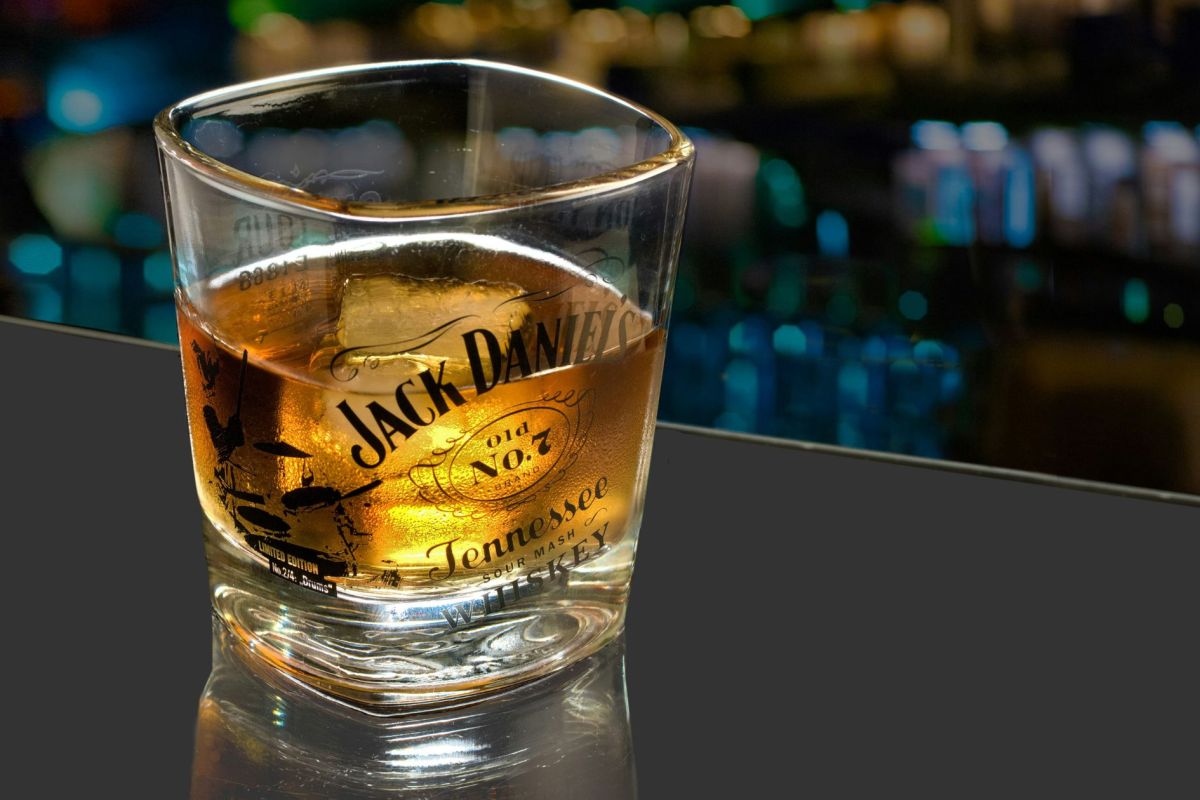
Jack Daniel's Tennessee Whiskey in square branded tumbler

Whether you call it whiskey or whisky, there’s always a reason to enjoy a dram. All over the world, people who enjoy whiskey get asked why they want something that “burns” or “just tastes like alcohol”.

As everybody has reasons for drinking, collecting and sharing the “Water of Life”, it’s always a good idea to find out why we drink it and why it’s so iconic.

Great conversation starter

It doesn’t matter if the person you’re talking to is a whiskey enthusiast or new to the amber spirit; the topic alone provides you with a starting point.

The question of their whiskey preference or if you can pour them a drink can turn into many topics. It can be as simple as “Yes, please” to find out it’s their favourite or something they’ve never tried. It opens up the opportunity to share stories of past experiences with whiskey, mini reviews of what’s in the glass, and reminiscing about non-whiskey topics while having a good laugh, and sipping something delicious.

The history of whiskey

Whisk(e)y has a long and storied history that started about a thousand years ago. Still, the last couple of hundred years are what we usually think about. It originated in Scotland and Ireland before spreading to Europe and the Americas. However, it’s the individual histories of distilleries like Jack Daniel and how a man known as Uncle Nearest taught him how to make whiskey.

There’s also our history with whiskey, including how we started drinking it, enjoying it, sometimes taking a different path, and hopping back on the whiskey train later on. These stories bring us together while making new memories that will become the tales we turn into our new histories down the road.

Variety

There is an enormous amount of whiskey worldwide and subcategories within well-known regions to which we often flock. Part of this whiskey journey comes from somewhere, and the real journey begins when we start colouring outside those lines and take the journey elsewhere. Sometimes, you can be the guide, helping a friend, new or old, try something they’ve never had before and in the past, that person was once you.

It can be as simple as trying Speyside Scotch whiskey like Glenfiddich to trying a heavily peated Islay Scotch like Laphroaig. Or, you can be a bourbon drinker trying out a Scottish single malt or Japanese whiskey for the first time.

The options are almost endless, and the variety keeps us on track.

Versatility

There will always be those who are hard-line neat whiskey drinkers, but we all know that “the best whiskey is the whiskey you like to drink, the way you like to drink it”, according to the Whiskey Tribe.

So, whether you like a block of ice and/or Coke with your drink or make a cocktail, of which there are hundreds of whiskey versions, anybody can enjoy any of the many varieties of whiskey the world has to offer without judgment.

It’s time to relax

There are those days when you want a bit of joy. Whether you’re about to sit down after a very long day and watch the sunset or about to meet some friends at the pub, whiskey has a way of calming the mind and making you feel better. Whether it’s just a flavour you love or that common reaction to alcohol, whiskey will provide the mood for relaxation.

Whiskey is well-loved and iconic, not just because of its history as the water of life but also because of the memories we make while enjoying it.

We all have different reasons to drink whiskey and explore this historic spirit. Still, one thing is for sure: it’s always best enjoyed with great people.