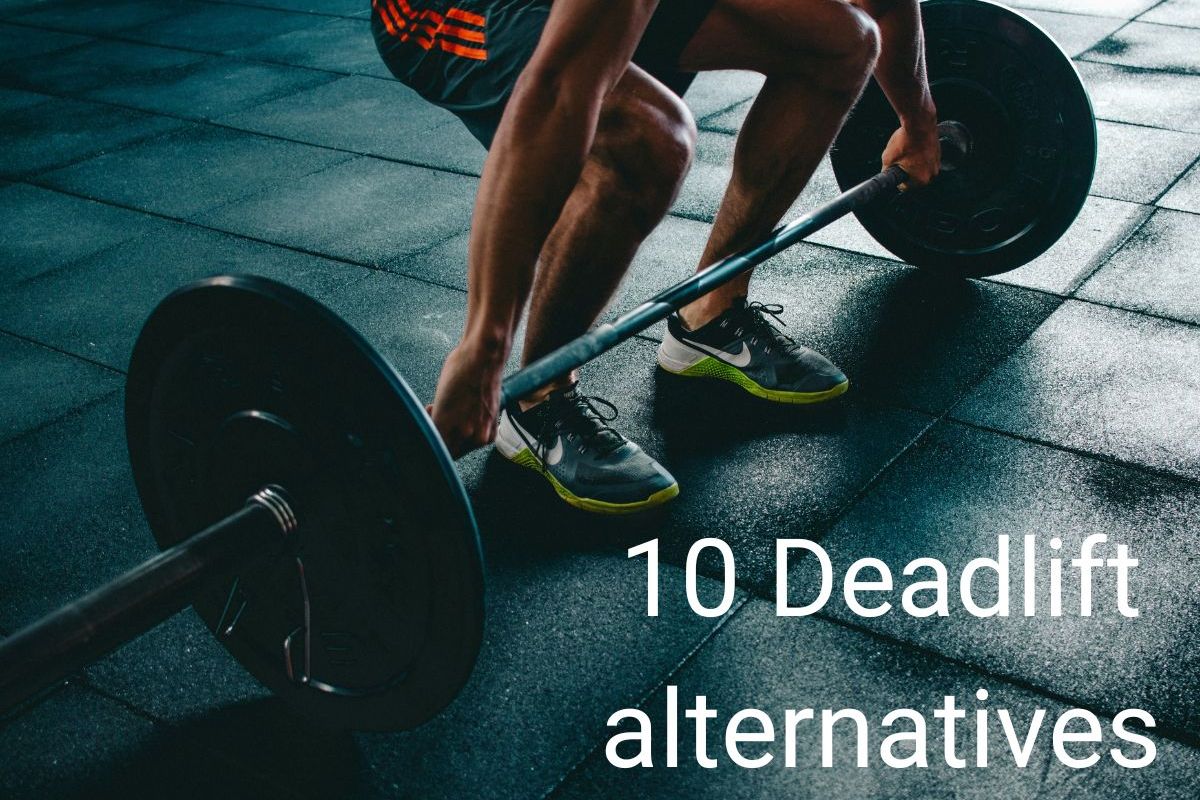
Deadlifts are often acknowledged as one of the primary lifts for strength or hamstring, glute, and back development. Being able to lift a heavy load off the floor is also one of the ultimate tests of strength, but what if there are no barbells available or you want to change things up for a while due to an injury or general training plateau? It’s great to change things up once in a while and if you’re set on doing a deadlift-style exercise, there are various options for you.
Conventional deadlift
First, let’s consider the conventional deadlift form. Even though cues will vary depending on the coach and individual, there are some basics to remember:
- Feet: Hip width apart and toes pointing almost straight forward.
- Shins: The Bar should be just over the midfoot and when grabbing the bar, should be pulled against the shins.
- Grip: Hands should be just wider than the feet at shoulder width. (Knees and thighs should push against the inside of the arms)
- Back: Lock your back in slight extension (lumbar and thoracic).
- Brace: Breathe into your abdomen and push your stomach, obliques, and back outward as if you’re about to get punched in the gut. If you have a belt, all sides should feel pressure.
- Shoulders: “Set” the shoulders and position the shoulder joint right over the hands.
- Shoulders > Hips > Knees: Shoulders are higher than the hips and the hips are higher than the knees.
- Drive through the feet and push your hips towards the bar as you pull it off of the floor. (Hips should not rise above the shoulders early).
The deadlift is a full-body exercise but it does emphasise the hamstrings, glutes, and erector spinae muscles of the back. Accessory muscles will include the quads and upper back muscles.
Non-barbell deadlift alternatives (heavy)
Trap bar deadlifts
What if you can’t find a barbell for deadlifts or you just want an alternative for a new training block? There are some non-barbell alternatives when you still want to lift heavier weights with a similar form pattern to conventional deadlifts. However, not all gyms will have these pieces of equipment.
Belt squat machine deadlifts:
Another piece of specialized equipment that has become more popular. Grab a wide-grip lat pulldown handle and attach it in place of the belt. This deadlift variation will often work similarly to the deficit deadlift due to the depth possible with most brands. You’ll also be able to have constant tension at a greater range of motion before reaching the bottom.
Just doing belt squats are also a great alternative for building leg size and strength, especially if you can’t overload your spine with a heavy barbell.
Non-barbell deadlift alternatives (light):
What if you want some of the benefits of deadlifts without needing to lift heavy? These alternatives are great for the general gym-goer, those with injuries, or if you just want a movement-specific warm-up before doing heavy deadlifts.
Kettlebell or Dumbbell deadlift
For many, the barbells are often in an area of the gym they want to avoid or they don’t have a barbell at home. Some people also just started training, so want an accessible piece of equipment to do lots of reps with. You can use either a narrower stance with the weights by your side for more quad engagement similar to a trap bar or have a wider (sumo) stance with the weight in front for more glute activation. This variation is also great for getting a full range of motion similar to creating a deficit.
Single-leg deadlift
If you’re training at home with lighter weights or want to target your hamstrings and glutes even more, single-leg deadlifts are great. By focusing on one leg at a time, you can use less weight and target one leg more effectively. This variation is also great for learning to keep your hips more stable as you hinge forward.
Don’t be afraid to lightly hold onto something for balance because you want to target the muscles and not worry about falling over.
Bulgarian split-squats
Everybody’s favourite exercise is here, right? Not only is this a perfect exercise for developing the legs, but it can also help you with improving other exercises. Even with lighter weights, Bulgarian split squats can make the legs work very hard, but it is important to work past the discomfort. If you use a full range of motion, you’ll work the entire posterior chain as well as the quads in front.
The leg drive on the front leg helps you activate as many muscles as possible while also improving the strength and mobility of the hip flexors on the back leg.
It’s also great as a warm-up or potentiation exercise for a heavy deadlift workout.
Non-conventional deadlift with barbell
What if you had a barbell but you wanted to change things up a little bit? The conventional deadlift is great but people often have “sticking points” in different areas of the lift or just want to directly target different muscles.
Sumo deadlift
The step-child of all deadlift variations, the sumo deadlift is still top of many lists. It is also allowed in most powerlifting federations. But, why would you want to try out this variation?
Due to the wider stance, you are using even more of your hamstrings and glutes to lift the weight. If perfected, you could lift more weight than you would doing a conventional lift. There are some pros and cons though:
- Even though you’re targeting the posterior chain even more, the range of motion is reduced, meaning that muscle growth is hindered. A fuller range of motion has been scientifically shown to provide more muscle growth.
- It’s useful for lifters with long femurs (thighs).
- Potentially more reps at heavier weights.
- Most people in the gym will judge you for lifting sumo.
Stiff-leg deadlift
Do you want to target your hamstrings even more? As we know, muscles get their best growth stimulus in the lengthened position. Doing stiff-leg deadlifts or Romanian deadlifts (RDLs) are a great way to target the hamstrings. However, stiff-leg deadlifts are better for power generation than they are for pure muscle growth.
With this variation, the exercise starts from the floor like a regular deadlift. You want to have your knees bent very slightly but your hips high and your shoulders ahead of the bar. Hips should still be pushed as far back as possible with the hamstrings stretched. Generate power from the floor, but keep the bar close to your body and hinge at your hips instead of the knees. Remember, you won’t be lifting very heavy and the slow essentric (lowering phase) should still be slow and controlled with shoulders pulled back and chest open.
Romanian deadlift
The technique is almost exactly like the stiff-leg deadlift but the movement starts at the locked-out position. Hinge at the hips and lower the bar as slowly as possible with knees only slightly bending later on. Slow lowering phase and athletic pull back to the top but touching the floor isn’t the goal. Your hamstrings should feel almost all of the stretch and contraction with a slight pause at the bottom.
Deficit deadlift
If your sticking point with the conventional deadlift is getting the initial pull from the floor, you could try adding a deficit. This is where you either stand on a small elevated platform or use smaller plates to get the bar lower.
Having the bar at a lower position forces you to have your hips lower, overload the initial pull position, activate more of your leg muscles like the quads and work past the difficult part of the movement.
Start with just about 5-10cm elevation like standing on some flat bumper plates.
Rack pulls/Box pulls
The opposite of deficit deadlifts, these are often used to help get past the knees. If you struggle to lock out your deadlift, have the bar on the safety pins of the power rack or boxes. The bar is usually just under the knees to help you lift more efficiently at the sticking point.
Where deficit deadlifts are usually lighter, rack pulls tend to work better at a heavier weight. You’ll be activating more of your hips, glutes, and back muscles here. The range of motion is very short, so it’s not advised for muscle building, but an accessory for power and deadlift strength.
Be aware, that dropping the bar in a rack will potentially be a bad idea for keeping your bar in good shape. Having the weight rest on boxes is a better idea. However, rack pulls will have no slack in the bar, and box pulls will, like a regular deadlift.
Which should you choose?
The deadlift might be one of the best tests of true strength but not everybody needs to lift anything near maximal weights. If you’re not competing in a sport that tests the deadlift directly or you just want to be as strong as possible, you don’t need to do them.
Any of the other variations like RDLs, kettlebell deadlifts, Bulgarian split squats, and others mentioned above are perfect for muscle building and still increasing strength. It will all depend on your goals and ability to perform the movement most effectively.
Written by Gary Dunn (@geekphysique_za)
 Cyclops Creative